Showing posts with label Sea monsters. Show all posts

Friday, September 12, 2014

Spinosaurus fossil: 'Giant swimming dinosaur' unearthed

http://www.bbc.co.uk/news/


Artist's impression of Spinosaurus 
 
 Spinosaurus is thought to be the largest known carnivore and would have feasted on huge fish and sharks

Related Stories

A giant fossil, unearthed in the Sahara desert, has given scientists an unprecedented look at the largest-known carnivorous dinosaur: Spinosaurus.
The 95-million-year-old remains confirm a long-held theory: that this is the first-known swimming dinosaur.
Scientists say the beast had flat, paddle-like feet and nostrils on top of its crocodilian head that would allow it to submerge with ease.
The research is published in the journal Science.
Lead author Nizar Ibrahim, a palaeontologist from the University of Chicago, said: "It is a really bizarre dinosaur - there's no real blueprint for it.
"It has a long neck, a long trunk, a long tail, a 7ft (2m) sail on its back and a snout like a crocodile.
"And when we look at the body proportions, the animal was clearly not as agile on land as other dinosaurs were, so I think it spent a substantial amount of time in the water."

While other ancient creatures, such as the plesiosaur and mosasaur, lived in the water, they are marine reptiles rather than dinosaurs, making Spinosaurus the only-known semi-aquatic dinosaur.
Spinosaurus aegyptiacus remains were first discovered about 100 years ago in Egypt, and were moved to a museum in Munich, Germany.
However, they were destroyed during World War II, when an Allied bomb hit the building.
A few drawings of the fossil survived, but since then only fragments of Spinosaurus bones have been found.
The new fossil, though, which was extracted from the Kem Kem fossil beds in eastern Morocco by a private collector, has provided scientists with a more detailed look at the dinosaur.
"For the very first time, we can piece together the information we have from the drawings of the old skeleton, the fragments of bones, and now this new fossil, and reconstruct this dinosaur," said Dr Ibrahim.

Reconstruction of Spinosaurus  
 
The dinosaur has a number of anatomical features that suggest it was semi-aquatic 
 
Life-size reconstruction of Spinosaurus 
  A life-size reconstruction of Spinosaurus is on display at the National Geographic Museum in Washington DC
 
The team says that Spinosaurus was a fearsome beast.
The researchers say that, at more than 15m (50ft) from nose to tail, it was potentially the largest of all the carnivorous dinosaurs - bigger even than the mighty Tyrannosaurus rex.
Scientists had long suspected that the giant could swim, but the new fossil offers yet more evidence for its semi-aquatic existence.
Dr Ibrahim explained: "The one thing we noticed was that the proportions were really bizarre. The hind limbs were shorter than in other predatory dinosaurs, the foot claws were quite wide and the feet almost paddle shaped.
"We thought: 'Wow - this looks looks like adaptations for a life mainly spent in water.'"
He added: "And then we noticed other things. The snout is very similar to that of fish-eating crocodiles, with interlocking cone-shaped teeth.
"And even the bones look more like those of aquatic animals than of other dinosaurs. They are very dense and that is something you see in animals like penguins or sea cows, and that is important for buoyancy in the water."
Its vast spiked dorsal sail, though, was probably more useful for attracting mates than aiding swimming.

Kem Kem fossil beds  
The fossil was unearthed from the Kem Kem fossil beds in Morocco
  
The researchers say that Spinosaurus lived in a place they describe as "the river of giants", a waterway that stretched from Morocco to Egypt.
They believe it would have feasted on giant sharks and other car-sized fish called coelacanths and lungfish, competing with enormous crocodile-like creatures for its prey.
Commenting on the research, Prof Paul Barrett, from London's Natural History Museum, said: "The idea that Spinosaurus was aquatic has been around for some time and this adds some useful new evidence to address that issue.
"But finding a more complete skeleton after the best material was destroyed in a WW2 bombing raid is significant, and this has allowed some surprising things to be found out about this animal.
"One of the things about this paper that struck me as particularly neat was the suggestion that Spinosaurus was a quadruped - all other meat-eating dinosaurs were bipeds. It would have moved in a really freaky, weird way in comparison with its relatives - whether on land or in water.
"One issue though, due to the way it was obtained - through a private collector - is that it would be good to get confirmation, such as the original excavation map, to show that all of the parts definitely came from a single skeleton."

Saturday, February 22, 2014

Uh-Oh: Giant Squid Sightings Considered an ‘Omen’ by Japanese Fishermen


Takepart.com

Giant squid were once the stuff of sea monster legend.
With their eyes (the biggest in the animal kingdom) and tentacles (they're more predatory than previously believed), these sea-dwelling creatures eluded humans for centuries, making their first cameo just two years ago. Now, giant squid are turning up with regularity off the Japanese coast. And like Captain Ahab before him, one Japanese fisherman suspects something fishy: It must be “some kind of omen.”
Such was the concern of Shigenori Goto, who “had seen no giant squid before in [his] 15-year fishing career.” Two weeks ago, he caught a 13-footer at Sadogashima Island.
“When I hauled up the net,” he told local reporters, “the squid slowly came floating up.”
The strange occurrences began earlier this year. A giant squid was caught in a stationary net near Sadogashima Island; another was found in a similar situation in the town of Iwami a few days later. Then, on Jan. 19, tentacles—presumably from a giant squid—washed up off the shore of Kashiwazaki, another coastal city.
Able to regenerate limbs, giant squid have tentacles that can extend up to 33 feet. The mollusks usually live about 2,000 feet below sea level, where water temperatures typically run 10 degrees Celsius.
So why are more giant squid being seen by humans? Tsunemi Kuboder of the country’s National Museum of Nature and Science, has a theory: With ocean temperatures dropping in the region this year, the giant squid may be abandoning the chilly ocean depths for the surface, where the water is warmer.

Friday, February 7, 2014

Scientists blown away by Tasmania's giant jellyfish


Reuters

SYDNEY (Reuters) - Residents of a sleepy hamlet in Tasmania found a previously unknown kind of giant jellyfish washed up on a beach, prompting excitement among scientists in Australia as they work to formally name and classify the creature.
About 1.5 meters (five feet) across, the white jellyfish with a pink spot in the middle is believed to be a relative of the lion's mane species popularly known as a "snotty" as it resembles mucus.
"There's the excitement, that it's a new species and then there's the 'Oh my God factor' that it happens to be the size of a Smart car," Lisa-ann Gershwin, a scientist at the government's Commonwealth Scientific and Industrial Research Organisation, told Reuters. "It's like Disneyland for marine biologists."
A family walking along the beach found the giant jellyfish in late January and sent a photo to the research organisation in Hobart, Australia's southernmost city. Scientists believe the jellyfish was later washed out to sea.
Gershwin and other scientists are also trying to discover why there has been an enormous rise in jellyfish populations in the waters around Tasmania this year.
"There's something going on that's causing a whole lot of species to bloom in staggering numbers and we don't know why yet," she said. "It's so thick with jellyfish that it's like swimming in bubble tea."
(Reporting by Pauline Askin; Editing by John O'Callaghan and Ron Popeski)

Sunday, January 12, 2014

Giant squid caught by net fisherman off Japan giant squid Images showing the giant squid being studied and captured are video screen grabs


Rare capture of fabled sea creature, at a depth of about 300 feet, measures 12 feet and weighs 330 pounds; and this one is no hoax


Images showing the giant squid being studied and captured are video screen grabs
A story published Thursday about a monstrous radioactive squid discovered on a Southern California beach was an obvious hoax.
But this past week off Japan, an actual giant squid was captured in a fisherman’s net and died after it was hauled to the surface.
The squid in the hoax story was said to be 160 feet long and its immense size was blamed on radiation being leaked into the Pacific in the aftermath of the 2011 Fukushima nuclear disaster.
“Alarms sound over radioactive gigantism,” screamed a headline above a story that featured a photoshopped image and quoted experts who do not exist.
giant squid
giant squid image is a video screen grab
Though some believed the story, fabricated by the Lightly Braised Turnip website, it was easily debunked.
But the capture of an actual giant squid Wednesday off Sadogashima Island is more believable, even though squid captures are exceedingly rare.
According to the Japan Times, the male specimen measured about 12 feet and weighed about 330 pounds. The accompanying Japanese-language video shows the creature on display and being measured by scientists (footage of the squid being pulled to the boat begins at the 1-minute mark).
Giant squid are elusive creatures that occupy the dark ocean depths. They’re believed to have spawned sea monster myths among ancient mariners, and have been featured as predatory beasts in novels and films.
They can measure to about 40 feet and weigh nearly a ton.
According to the Smithsonian Ocean Portal, a giant squid was first recorded live in 2006 by Japanese scientists who used a baited hook to haul up a 24-foot squid.
In 2012, scientists from Japan’s National Science Museum and a Discovery Channel film crew filmed a giant squid in its natural habitat for the first time.
It was enticed to within view of a submersible camera by the use of glowing lowers designed to mimic sea jellies, which are said to signal squid that other food is nearby.
The capture on Wednesday was by a fisherman named Shigenori Goto, who told the Japan Times that it was found in a net used to catch buri yellowtail at a depth of 310 feet.
According to the video description, the collosal cephalopod is being studied at the Fisheries Ocean Research Institute in Niigata Prefecture.
Almost assuredly, some people will associate this rare catch with the Fukushima disaster.
–Find Pete Thomas on Facebook and Twitter

Saturday, November 2, 2013

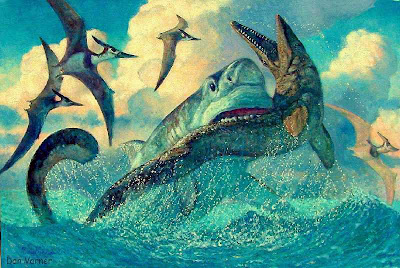
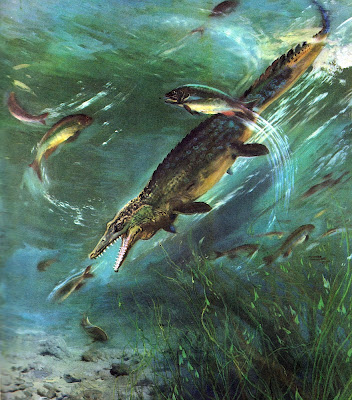
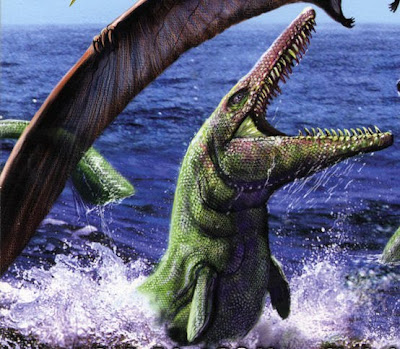
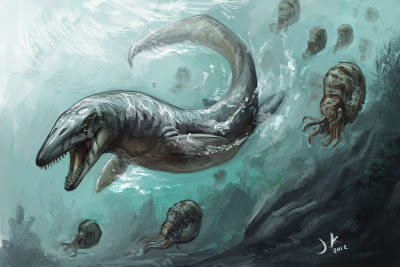
Mosasaur Pics

https://blogger.googleusercontent.com/img/b/R29vZ2xl/AVvXsEh9mXHBQCnCviNyzdYEc9XXlH74R9oHYWsYmsWQz7ESjxViikcPooeqicaJYcMk5bjCy9bnPDeBVNxyubEagn2hc_kt7D-U_gO55syFlD0WzFGvHjbO1uoGMBe-FqLRfDhw_QLoZQGK5YM/s1600/varn11.jpg

http://www.fossilguy.com/gallery/vert/fish-shark/carcharocles/megalodon_size_comparison.jpg

http://i1.ytimg.com/vi/gGzM2Md92IY/maxresdefault.jpg?feature=og

http://netstorage.discovery.com/feeds/brightcove/asset-stills/dsc/125192709507712910300601197_SharkVsMosasaur.jpg

https://blogger.googleusercontent.com/img/b/R29vZ2xl/AVvXsEjsC84LM2oMpMrhtQZka2hbrjF1KGBDFWMm_fik7YIG7fM7dDGFPPPlmR2lkwKqlvno_hACK20d5j9YzSaCFPiAea_9RLdhIP6T2WydAC4hzx5_0ERJvQXLbE0AltR30WhWLR0oa2Pl1rbs/s1600/beneath_the_surface_by_patriatyrannus-d4h5chy.png

http://www.plesiosauria.com/images/life_restorations/elasmosaurus_mosasaur_buian.jpg

 http://fc01.deviantart.net/fs71/i/2011/245/9/9/mosasaur_copic_sketch_by_maus_by_billmausart-d48o9lp.jpg

 http://i.livescience.com/images/i/000/018/500/i02/4_mosasaur_lineupedited.jpg?1311973762

http://th00.deviantart.net/fs27/PRE/f/2008/134/6/7/mosasaurus_and_sharks_by_dewlap.jpg
 https://blogger.googleusercontent.com/img/b/R29vZ2xl/AVvXsEgAn9PQIyXBfQKcfDxxxhELBjlxaApJ0ccBXkTOTrVBFupSq_IURv80YA_q0ynVxrbGV7x5HJB1VWg_4ls2jMwJjDM4ZtkOyVCxemdv1fpMAwUbsSp_4RE3_dhEfANQ_N6i54nn9Q0IiXQ/s1600/Mosasaur.jpg

 http://www.oceansofkansas.com/YoungMosasaurs/MosaBirth.jpg

 http://www.oceansofkansas.com/Varner/Varner16.jpg


http://www.fabiopastori.it/images/big/229.jpg

http://serc.carleton.edu/images/introgeo/earthhistory/mosasaur.jpg

http://www.oceansofkansas.com/Mosa-Rapid/figure2.jpg

http://www.oceansofkansas.com/Mosa-Rapid/varnr23.jpg

http://ih3.redbubble.net/image.4832131.8313/flat,550x550,075,f.jpg

https://www.dmr.nd.gov/ndfossil/poster/pierre/images/mosasaur-2%20cropped.jpg

https://www.dmr.nd.gov/ndfossil/poster/pierre/images/as%2004%20copy.gif

https://blogger.googleusercontent.com/img/b/R29vZ2xl/AVvXsEgf8mBwvCGga9FPj0neh9AraxEtghgmN65PJgObYr8lv52IH9QPjGDp_s2PgV1vU9NDEsZcdzd8u10AbIKtGgTRGpMTq8FjOfibCdikjhyphenhyphenkl5Ocqf-cAGFA3_8enUInyTfeyGfzzHEx7BBw/s400/Luis+Rey+Mosasaur.jpg

https://blogger.googleusercontent.com/img/b/R29vZ2xl/AVvXsEg7L6bT29FqZlXsnkSqbQ3spFzENWT9gMTVSZqJikegcxf7HH2Vduk6X7afkjjty-dgm7tfWAdBxycl3nk5Ws2MMTGpOHE4hVc7ENbwf1VTKLIughSLnBTNHqHa2UKFGXVuWBHE4-uNYZU/s1600/mosasaur2.jpg

http://www.dinosaursrocksuperstore.com/v/vspfiles/assets/images/mosasaurskullgiant.jpg

https://blogger.googleusercontent.com/img/b/R29vZ2xl/AVvXsEhQeK_UjTrcy45yCStGD235wLmoaD9Qo4sezjhCNm2nBQ_W_S0zp-bVEuhYH8RA_zZbccfOeNLxI9-lq9An7uBK_w230D4MXB55ACZrqhsXHJAShBwL5_OZNqjFsreNM0NRkM6gc0Myt-I/s320/DSC_2356.JPG

http://farm7.static.flickr.com/6041/6237060577_3ac6fea82e_b.jpg


http://www.oceansofkansas.com/Varner/varner.jpg

http://www.oceansofkansas.com/Varner/varn02.jpg

http://www.oceansofkansas.com/Varner/varner01.jpg

http://www.finefossils.com/images/products/large_296_3.jpg

http://www.oceansofkansas.com/Clidastes/varn07b.jpg

http://pancreas42.edublogs.org/files/2010/06/miller_mosasaur_jpg.jpg
http://www.freewebs.com/laurafox/mosasaur.jpg

Mosasaur fossil proves the early lizards had tails like sharks

Sep 11, 2013 by Bob Yirka report
Mosasaur fossil proves the early lizards had tails like sharks
The first mosasaur tail on record with a preserved soft tissue outline. In similarity with whales and ichthyosaurs, mosasaurs were equipped with semilunate caudal flukes, and they presumably swam like pelagic sharks. Credit: Johan Lindgren
(Phys.org) —A trio of researchers studying a mosasaur fossil found in Jordan report in their paper published in the journal Nature Communications, that the late cretaceous period reptile clearly had a hypocercal (shark-like) tail fin. The fossil was first discovered in 2008 by workers digging at a quarry—it then sat unstudied in Eternal River Museum of Natural History in Amman for four years before this new team of researchers from Sweden, Jordan and the U.S. discovered its existence and began giving it a closer look.
Mosasaurs lived approximately 98 to 66 million years ago during a time when were much higher. In their early history, they had legs and feet and likely resembled modern monitor lizards—after moving into shallow lakes, streams and eventually the ocean, they adapted by becoming more streamlined and developed fins and tails. Despite scientists unearthing hundreds of mosasaur fossils, until now, it wasn't known what sort of tail they had developed—none of the specimens found had preserved tail parts. Because they are a part of the lizard family, scientists assumed their tails tapered to a point, which would mean they would have had to swim more like eels, than fish. This new find proves otherwise. Instead of a tapered appendage, mosasaurs developed what looks like upside down shark tail—a development that would have enabled the predators to swim very fast, allowing them to catch most anything in their vicinity.
The found was that of a juvenile, approximately six feet long—adults are believed to have grown to an average of 33 feet. Though small it marks the first instance of a mosasaur fossil with fins, including the tail, almost completely intact. The find settles the debate about which kind of the air-breathing swimming lizard had and has caused paleontologist to revisit theories regarding what life in the oceans during the must have looked like. If masasaurs, which scientists already believed dominated the seas during their time, were able to swim much faster than has been previously thought, it means that other swimmers in the sea likely had to develop adaptations to elude them.
Mosasaur fossil proves the early lizards had tails like sharks
ERMNH HFV 197 reveals, for the first time in a mosasaur, the soft tissue outline of a tail fin, to demonstrate that mosasaurs are convergent with ichthyosaurs and whales in the development of a semilunate propulsive surface for enhanced …more

Explore further: First freshwater mosasaur discovered
More information: Soft tissue preservation in a fossil marine lizard with a bilobed tail fin, Nature Communications 4, Article number: 2423 DOI: 10.1038/ncomms3423
Abstract
Mosasaurs are secondarily aquatic squamates that became the dominant marine reptiles in the Late Cretaceous about 98–66 million years ago. Although early members of the group possessed body shapes similar to extant monitor lizards, derived forms have traditionally been portrayed as long, sleek animals with broadened, yet ultimately tapering tails. Here we report an extraordinary mosasaur fossil from the Maastrichtian of Harrana in central Jordan, which preserves soft tissues, including high fidelity outlines of a caudal fluke and flippers. This specimen provides the first indisputable evidence that derived mosasaurs were propelled by hypocercal tail fins, a hypothesis that was previously based on comparative skeletal anatomy alone. Ecomorphological comparisons suggest that derived mosasaurs were similar to pelagic sharks in terms of swimming performance, a finding that significantly expands our understanding of the level of aquatic adaptation achieved by these seagoing lizards.

http://phys.org/

Mosasaur from Wikipedia

From Wikipedia, the free encyclopedia


Mosasaurs
Temporal range: Late Cretaceous
O
S
D
C
P
T
J
K
N
Mosasaurus hoffmannii skeleton, Natural History Museum of Maastricht, The Netherlands
Scientific classification e
Kingdom: Animalia
Phylum: Chordata
Clade: Sauropsida
Order: Squamata
Superfamily: Mosasauroidea
Family: Mosasauridae
Gervais, 1853
Subfamilies
Mosasaurs (from Latin Mosa meaning the 'Meuse river', and Greek σαύρος sauros meaning 'lizard') are large, extinct, marine reptiles. The first fossil remains were discovered in a limestone quarry at Maastricht on the Meuse in 1764. Mosasaurs probably evolved from semiaquatic squamates[1] known as aigialosaurs, which were more similar in appearance to modern-day monitor lizards, in the Early Cretaceous. During the last 20 million years of the Cretaceous period (Turonian-Maastrichtian), with the extinction of the ichthyosaurs and decline of plesiosaurs, mosasaurs became the dominant marine predators.

Description

Restoration of Prognathodon saturator with asymmetrically bi-lobed tail fluke
Tylosaurus proriger erroneously depicted with a dorsal crest and no tail fluke, by Charles R. Knight, 1899
 
Mosasaurs breathed air, were powerful swimmers, and were well-adapted to living in the warm, shallow, epicontinental seas prevalent during the Late Cretaceous Period. Mosasaurs were so well adapted to this environment that they gave birth to live young, rather than return to the shore to lay eggs, as sea turtles do.
The smallest-known mosasaur was Carinodens belgicus, which was about 3.0 metres (9.8 ft) to 3.5 metres (11 ft) long and probably lived in shallow waters near shore, cracking mollusks and sea urchins with its bulbous teeth. Larger mosasaurs were more typical: Hainosaurus holds the record for longest mosasaur, at 17.5 metres (57 ft).
Mosasaurs had a body shape similar to that of modern-day monitor lizards (varanids), but were more elongated and streamlined for swimming. Their limb bones were reduced in length and their paddles were formed by webbing between their elongated digit-bones. Their tails were broad, and supplied the locomotive power. This method of locomotion may have been similar to that used by the conger eel or sea snakes today. However, more recent evidence suggests many advanced mosasaurs had large crescent-shaped flukes on the ends of their tails similar to those of sharks and ichthyosaurs. Rather than snake-like undulatory movement, their bodies probably remained stiff in these mosasaurs to improve hydrodynamic efficiency through the water, while the end of their tails provided strong propulsion.[2] The animal may have lurked and pounced rapidly and powerfully on passing prey, rather than hunting for it. A juvenile Prognathodon found in Jordan's Harrana Site in 2008 and described in 2013 supports this, as the outline of its tail fluke was also preserved with the skeleton.[3]
Early reconstructions showed mosasaurs with dorsal crests running the length of their bodies, which were based on misidentified tracheal cartilage. When the error was discovered, depicting mosasaurs with such crests was already a trend.[4][5]

Paleobiology

Fossil shell of ammonite Placenticeras whitfieldi showing punctures caused by the bite of a mosasaur, Peabody Museum of Natural History, Yale
 
Mosasaurs had double-hinged jaws and flexible skulls (much like that of a snake), which enabled them to gulp down their prey almost whole, a snake-like habit which helped identify the unmasticated gut contents fossilized within mosasaur skeletons. A skeleton of Tylosaurus proriger from South Dakota included remains of the diving seabird Hesperornis, a marine bony fish, a possible shark, and another, smaller mosasaur (Clidastes). Mosasaur bones have also been found with shark teeth embedded in them.
One of the food items of mosasaurs were ammonites, molluscs with shells similar to that of Nautilus, which were very abundant in the Cretaceous seas. On fossil shells of some ammonites (mainly Pachydiscus and Placenticeras) were found round holes, once interpreted as a result of limpets attaching themselves to the ammonites. The triangular formation of the holes, their size and shape, and their presence on both sides of the shells, corresponding to the upper and lower jaws, is evidence of the bite of medium-sized mosasaurs. It is not clear if this behaviour was common across all size classes of mosasaurs.
Virtually all forms were active predators of fish and ammonites; a few, such as Globidens, had blunt spherical teeth, specialized to crush mollusk shells. The smaller genera, such as Platecarpus and Dallasaurus, which were about 1–6 m (10–20 ft) long, probably preyed on fish and other small prey. The smaller mosasaurs may have spent some time in fresh water, hunting for food. The larger mosasaurs, such as Tylosaurus, and Mosasaurus, reached sizes of 10–15 m (33–49 ft) long, and were the apex predators of the Late Cretaceous oceans, attacking other marine reptiles, in addition to preying on large fish and ammonites.

Soft tissue

Scales of Tylosaurus proriger (KUVP-1075)
 
Despite the relatively high number of mosasaur remains collected worldwide, knowledge of the nature of their skin coverings remains in its early stages. An incredibly small amount of mosasaurid specimens collected from around the world retain fossilized scale imprints; this lack of knowledge is possibly due to the delicate nature of the scales, which nearly eliminates possibility of preservation, in addition to the preservation sediments types and the marine conditions under which the preservation occurred. Until the discovery of several mosasaur specimens along with their remarkably well-preserved scale imprints from late Maastrichtian deposits of the Muwaqqar Chalk Marl Formation of Harrana[6] in Jordan, knowledge of the nature of mosasaur integument was mainly based on very few accounts describing early mosasaur fossils dating back to the upper Santonian-lower Campanian, such as the famous Tylosaurus specimen (KUVP-1075) from Cove County, Kansas.[7] Material from Jordan has shown that the bodies of mosasaurs, as well as the membranes between their fingers and toes, were covered with small, overlapping, diamond-shaped scales resembling those of snakes. Much like modern reptiles, regional variations existed in the type and size of the scales that covered the mosasaurs. In Harrana specimens, two types of scales were observed on a single specimen,[6] keeled scales covering the upper regions of the body, as well as smooth scales covering the lower regions. As ambush predators, lurking and quickly capturing prey using stealth tactics,[8] they are suggested to have benefited greatly from the nonreflective, keeled scales.[6]
Soft tissues in the head and neck of Platecarpus tympaniticus specimen LACM 128319: Tracheal rings are shown in the bottom three photographs.
 
More recently, a well-preserved fossil of Platecarpus tympaniticus has been found that preserved not only skin impressions, but also internal organs. Several reddish areas in the fossil may represent the heart, lungs, and kidneys. The trachea is also preserved, along with part of what may be the retina in the eye. The placement of the kidneys is farther forward in the abdomen than it is in monitor lizards, and is more similar to those of cetaceans. As in cetaceans, the bronchi leading to the lungs run parallel to each other instead of splitting apart from one another as in monitors and other terrestrial reptiles. In mosasaurs, these features may be internal adaptations to fully marine lifestyles.[2]
Fibrous tissues and microstructures recovered from Prognathodon specimen IRSNB 1624
In 2011, collagen protein was recovered from a Prognathodon humerus dated to the Cretaceous.[9]

Environment

Sea levels were high during the Cretaceous period, causing marine transgressions in many parts of the world, and a great inland seaway in what is now North America. Mosasaur fossils have been found in the Netherlands, Belgium, Denmark, Portugal, Sweden, Spain, France, Germany, Poland, Bulgaria, the United Kingdom,[10][11] Russia, Ukraine, Kazakhstan, Azerbaijan,[12] Japan,[13] Egypt, Israel, Jordan, Syria,[14] Turkey,[15] Niger,[16][17] Angola, Morocco, Australia, New Zealand, and on Vega Island off the coast of Antarctica. Tooth taxon Globidens timorensis is known from the island of Timor; however, the phylogenetic placement of this species is uncertain and it might not even be a mosasaur.[18] Mosasaurs have been found in Canada in Manitoba and Saskatchewan[19] and in much of the contiguous United States. Complete or partial specimens have been found in Alabama, Mississippi, Tennessee, and Georgia, as well as in states covered by the Cretaceous seaway: Texas, southwest Arkansas, New Mexico, Kansas,[20] Colorado, Nebraska, South Dakota, Montana, and the Pierre Shale/Fox Hills[disambiguation needed] formations of North Dakota.[21] Lastly, mosasaur bones and teeth are also known from California, Mexico, Colombia,[22] Brazil,[14] Peru, and Chile.[23]
Many of the so-called 'dinosaur' remains found on New Zealand are actually mosasaurs and plesiosaurs, both being Mesozoic predatory marine reptiles.

Discovery

The Mosasaurus hoffmannii skull found in Maastricht between 1770 and 1774
 
The first publicized discovery of a partial fossil mosasaur skull in 1764 by quarry workers in a subterranean gallery of a limestone quarry in Mount Saint Peter, near the Dutch city of Maastricht, preceded any major dinosaur fossil discoveries, but remained little known. However, a second find of a partial skull drew the Age of Enlightenment's attention to the existence of fossilized animals that were different from any known living creatures. When the specimen was discovered between 1770 and 1774, Johann Leonard Hoffmann, a surgeon and fossil collector, corresponded about it with the most influential scientists of his day, making the fossil famous. The original owner, though, was Godding, a canon of Maastricht cathedral.
When the French revolutionary forces occupied Maastricht in 1794, the carefully hidden fossil was uncovered, after a reward, it is said, of 600 bottles of wine, and transported to Paris. After it had been earlier interpreted as a fish, a crocodile, and a sperm whale, the first to understand its lizard affinities was the Dutch scientist Adriaan Gilles Camper in 1799. In 1808, Georges Cuvier confirmed this conclusion, although le Grand Animal fossile de Maëstricht was not actually named Mosasaurus ('Meuse reptile') until 1822 and not given its full species name, Mosasaurus hoffmannii, until 1829. Several sets of mosasaur remains, that had been discovered earlier at Maastricht but were not identified as mosasaurs until the 19th century, have been on display in the Teylers Museum, Haarlem, procured from 1790.
The Maastricht limestone beds were rendered so famous by the Mosasaur discovery, they have given their name to the final six-million-year epoch of the Cretaceous, the Maastrichtian.


Evolutionary antecedents

Restoration of Aigialosaurus bucchichi, a basal mosasaur
 
Based on features such as the double row of pterygoid ("flanged") teeth on the palate, the loosely hinged jaw, modified/reduced limbs and probable methods of locomotion, many researchers believe that snakes share a common marine ancestry with mosasaurs, a suggestion advanced in 1869, by Edward Drinker Cope, who coined the term "Pythonomorpha" to unite them. The idea lay dormant for more than a century, to be revived in the 1990s.[25][26] Recently, the discovery of Najash rionegrina, a fossorial snake from South America cast doubt on the marine origin hypothesis.
The skeleton of Dallasaurus turneri, described by Bell and Polcyn (2005), has a mixture of features present in the skeletons of derived mosasaurs and in the skeletons of mosasaurid ancestors such as aigialosaurids. Dallasaurus retains facultatively terrestrial limbs similar in their structure to the limbs of aigialosaurids and terrestrial squamates (plesiopedal limb condition), unlike derived mosasaurids which evolved paddle-like limbs (hydropedal limb condition). However, the skeleton of Dallasaurus simultaneously had several characters that linked it with derived members of the subfamily Mosasaurinae; the authors of its description listed "invasion of the parietal by medial tongues from the frontal, teeth with smooth medial enamel surface, high coronoid buttress on surangular, interdigitate anterior scapulo-coracoid suture, humeral postglenoid process, elongate atlas synapophysis, sharp anterodorsal ridge on synapophyses, vertically oriented vertebral condyles, elongate posterior thoracic vertebrae, and fused haemal arches" as the characters uniting Dallasaurus with Mosasaurinae.[27] The phylogenetic analysis conducted by Bell and Polcyn indicated that hydropedal mosasaurids did not form a clade that wouldn't also include plesiopedal taxa such as Dallasaurus, Yaguarasaurus, Russellosaurus, Tethysaurus, Haasiasaurus and Komensaurus (in 2005 only informally known as "Trieste aigialosaur"); the analysis indicated that hydropedal limb condition evolved independently in three different groups of mosasaurs (Halisaurinae, Mosasaurinae and the group containing the subfamilies Tylosaurinae and Plioplatecarpinae).[27][28] The result of this phylogenetic study was subsequently mostly confirmed by the analyses conducted by Caldwell and Palci (2007) and Leblanc, Caldwell and Bardet (2012);[24][29] the analysis conducted by Makádi, Caldwell and Ősi (2012) indicated that hydropedal limb condition evolved independently in two group of mosasaurs (in Mosasaurinae and in the clade containing Halisaurinae, Tylosaurinae and Plioplatecarpinae).[30] Conrad et al. (2011), on the other hand, recovered hydropedal mosasaurs forming a clade that excluded their plesiopedal relatives.[31] If the hypothesis of Bell and Polcyn (2005) is correct, then mosasaurs in the traditional sense of the word, i.e. "lizards that evolved paddle-like limbs and radiated into aquatic environments in the late Mesozoic, going extinct at the end of that era",[28] are actually polyphyletic; Bell and Polcyn (2005) maintained monophyletic Mosasauridae by including Dallasaurus and other aforementioned plesiopedal taxa in the family as well,[27] while Caldwell (2012) suggested (though explicitly stated that it was not "a formal proposal of new nomenclature") to restrict Mosasauridae only to the genus Mosasaurus and its closest hydropedal relatives.[28]
The exact phylogenetic position of the clade containing mosasaurids and their closest relatives (aigialosaurids and dolichosaurs) within Squamata remains uncertain. Some cladistic analyses recovered them as the closest relatives of snakes,[32][33] taking into account similarities in jaw and skull anatomies;[32] however, this has been disputed[34][35][36] and the morphological analysis conducted by Conrad (2008) recovered them as varanoids closely related to terrestrial monitor lizards instead.[34] Subsequent analysis of anguimorph relationships conducted by Conrad et al. (2011) based on morphology alone recovered mosasaurids, aigialosaurids and dolichosaurs as anguimorphs lying outside the least inclusive clade containing monitor lizards and helodermatids; the analysis based on combined datasets of morphological and molecular data, on the other hand, found them more closely related to monitor lizards and the earless monitor lizard than helodermatids and the Chinese crocodile lizard were.[31] The large morphological analysis conducted by Gauthier et al. (2012) recovered mosasaurids, aigialosaurids and dolichosaurids in an unexpected position as basal members of the clade Scincogekkonomorpha (containing all taxa sharing a more recent common ancestor with Gekko gecko and Scincus scincus than with Iguana iguana[34]) that didn't belong to the clade Scleroglossa. The phylogenetic position of these taxa turned out to be highly dependent on which taxa were included in or excluded from the analysis. When mosasaurids were excluded from the analysis, dolichosaurs and aigialosaurids were recovered within Scleroglossa, forming a sister group to the clade containing snakes, amphisbaenians, dibamids and the American legless lizard. When mosasaurids were included in the analysis, and various taxa with reduced or absent limbs other than snakes (such as dibamids or amphisbaenians) were excluded, mosasaurids, aigialosaurids and dolichosaurs were recovered inside Scleroglossa forming the sister group to snakes.[37] Longrich, Bhullar and Gauthier (2012) conducted a morphological analysis of squamate relationships using a modified version of the matrix from the analysis of Gauthier et al. (2012); they found the phylogenetic position of the clade containing mosasaurs and their closest relatives within Squamata to be highly unstable, with the clade "variously being recovered outside Scleroglossa (as in Gauthier et al., 2012) or alongside the limbless forms".[38]