Showing posts with label Mesozoic Era. Show all posts

Monday, March 7, 2016

Dinosaur-era geckos and chameleons perfectly preserved in amber

https://www.newscientist.com/

Lizards in amber
Gloriously well preserved
Florida Museum of Natural History/Kristen Grace
They probably hid from feathered dinosaurs, only to end up stuck in redwood sap.
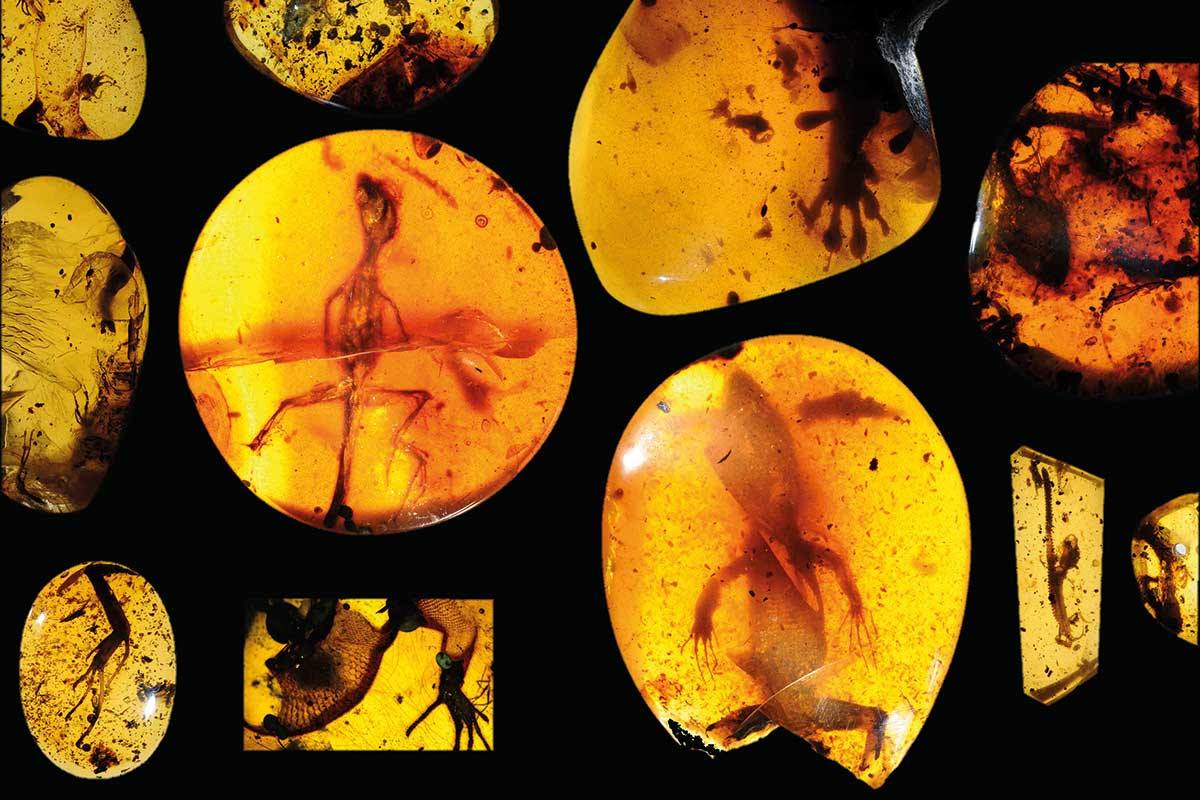
A new collection of 12 lizards preserved in amber dates back to middle of the Cretaceous period – when dinosaurs such as the massive Argentinosaurus were still around – and may include the ancestors of geckos and chameleons.
The specimens come from Myanmar’s Kachin state and are thought to have lived in tropical forest. Each is embedded in Burmese amber, which previous studies dated to about 100 million years old. Previously, we knew of only a few fragments of amber lizards from the time of the dinosaurs – when modern lizard groups first evolved, according to genetic analyses.
The lizards, discovered in private amber collections on loan to the American Museum of Natural History and Harvard University, are immaculate and unusually diverse. As such they suggest that major lizard groups were already established at that time. The specimens will now go on display at the Houston Museum of Natural Science.
“One of them is perhaps the best fossil gecko that is known in the world,” says Juan Daza of Sam Houston State University in Texas, whose team revealed the finds, and then used CT scans to study them (click on image below). It was so detailed the team initially thought it looked like a modern animal.
Lizard scans
Florida Museum of Natural History/Kristen Grace
But it wasn’t recent. “We started looking at the characteristics we describe in modern species, and none of those match,” Daza says. The adhesive toe pads are already present in these ancient specimens, suggesting the gecko’s climbing lifestyle evolved much earlier than thought.
Another specimen has its tongue stuck out. With a narrow, extended tip, it matches no snake or lizard tongue ever found.
One small lizard is trapped next to a scorpion-like animal and a millipede. That proximity, plus the fact that modern lizards in tropical forests hunt arthropods, suggest these animals preyed on them, Daza says.
That particular lizard is doubly interesting. Its bone structure resembles that of a newborn chameleon, although it is about four times the age of the oldest chameleon-like fossils previously known.
It even has a weak jaw, which wouldn’t be good for biting prey – possible evidence that the modern chameleon’s method of grabbing prey with a projectile tongue is really an old adaptation, Daza says. The find may also challenge current view that chameleons originated in Africa.
The new specimens are beautiful and very exciting, says Michael Caldwell of the University of Alberta in Edmonton, Canada. “We really have had little to no previous fossil record detailing that part of the family tree of lizards,” he says.
But closer anatomical studies are now needed to determine where each lizard is best classified – especially the putative chameleon, he adds.

Read more: Stunning fossils: The seven most amazing ever found

Tuesday, February 2, 2016

Yes, this prehistoric fish actually had a buzzsaw of spiraling teeth

Scientific Method / Science & Exploration

It takes an artist to capture the true weirdness of the ancient animal's face.

LOOK INTO MY TEETH AND DESPAIR.
Nicknamed the "buzzsaw shark," this 270 million-year-old creature is actually an extinct relative of the ratfish called a Helicoprion. Its bizarre tooth arrangement has confused scientists for over a century, but one artist finally got it right.
Ray Troll, whose art show about Hilicoprion has been touring the US for the past three years, has been on the front lines of scientific research about one of the strangest fossils ever found. When geologist Alexander Petrovich Karpinsky discovered the creature's tooth whorl in 1899, at first he thought it was a kind of ammonite because the teeth looked so much like the ammonite's spiral shell.
Paleo expert Brian Switek writes that it took Karpinsky a little while to realize that it was actually part of a larger animal. Over the next century, many different paleontologists offered explanations for what it might be, including a defensive formation on Helicoprion's nose, a ridge on its back, or even sticking out of its mouth like a spiky, curled tongue.
Enlarge / All the different ways that scientists have tried to 
explain where Helicoprion's spiral teeth were positioned.
Over at the Smithsonian, there's a great profile of Troll, who has done
a lot more than make art of this crazy fish. He's actually added to the
scholarship on it:
Troll’s passion, however, has served a purpose far beyond the aesthetic charm of a framed picture—it has shaped the scientific community’s knowledge of Helicoprion itself. Back in the mid-1990s, when he wrote and spoke with [paleontologist Svend Erik Bendix] Almgreen, Troll discovered that the scientist had published his hypothesis about the buzz shark’s physiology in an obscure paper in 1966. This knowledge remained hidden, lost to memory even to prominent paleontologists, until 2010, when an undergraduate student working as an intern at the Idaho Museum of Natural History got in touch with Troll.
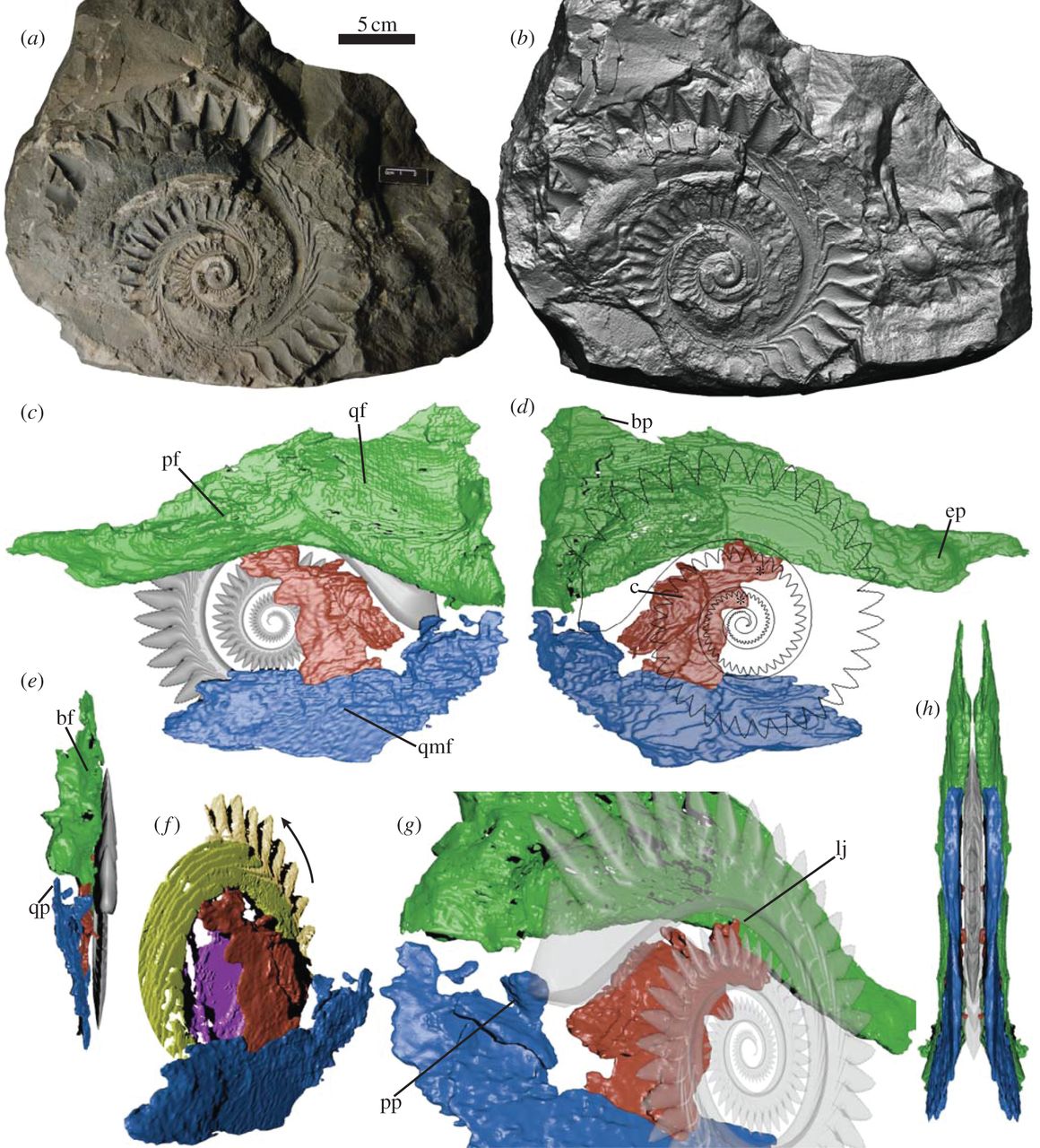
As a result, Troll began working with paleontologist Leif Tapanila, who used used CT scans to image a whole skull of a Helicoprion—revealing that the buzzsaw shape was actually part of its lower jaw, used for slicing food and pushing it toward the back of the fish's mouth. It seems that the teeth formed in the jaw next to the topmost part of the spiral, then gradually worked their way down and back into the jaw. Once there, the teeth would be absorbed into cartilage and eventually turned into teeth again. These scans became the basis for an article published in 2013 in Biology Letters, which also included some of Troll's artwork of the buzzsaw in its rightful place.
Enlarge / Here you can see the fossils that Tapanila put into the CT scanner, along with the structure they revealed.
Royal Society
Troll's drawings and sculptures, which are still touring the US today (currently they are at the University of Oregon's Museum of Natural and Cultural History), are a reminder that paleoartists contribute a great deal to scientific discovery. Taking a whimsical approach, Troll called his show "The Buzz Sharks of Long Ago." His goofy humor is a perfect way to shine light on the truth of natural history, which is often so weird that it might as well be art.

Tuesday, December 29, 2015

Scientists discover furry new post-apocalyptic critter that survived demise of the dinosaurs

Sixty-six million years ago, a chunk of space rock the size of a mountain slammed into the Earth. The planet would never be the same.
Debris from the impact went flying into the air, forming clouds so thick they blocked out the sun. Earthquakes shook the ground and sent massive tsunami waves roiling toward shorelines. At the same time — maybe unrelated to the impact, maybe exacerbated by it — a vast flow of lava was flooding across India, oozing ash and noxious gases that caused the climate to fluctuate like a yo-yo and may have helped kill off anything that survived the initial cataclysm.
It was not a good time to be alive, and most species made a swift exit from the global stage: Vegetation withered. Ocean life gasped for air and energy, then collapsed. Gone were the fearsome Tyrannosaurus, the winged Pterosaurs, the massive Triceratops with its three horns and bony neck frill. The dinosaurs’ 100 million-year reign had ended. And when the smoke cleared, a new hero had taken over.
It was buck-toothed and furry and had the goofy appearance of a character from a children’s cartoon. Instead of Earth-shaking stomps, it likely moved with a rodent’s fearful scurry.
Its name is Kimbetopsalis simmonsae, scientists say in a paper published Monday in the Zoological Journal of the Linnean Society. And although it was only about three feet long and no more intimidating than a beaver, it was one of the largest animals around. If Tyrannosaurus was the king of the Cretaceous, Kimbetopsalis was early royalty during the millennia that followed — an era we now call the “Age of the Mammals.”
Kimbetopsalis, which was recently discovered among the shifting sands and spooky rock formations of New Mexico’s badlands, was something of an evolutionary dark horse. First born in the Jurassic period, the fuzzy creature (creatures really — Kimbetopsalis represents a whole new genus) bided its time for a million centuries while dinosaurs tromped about.
After the meteorite-induced apocalypse, “all this ecological space became available and the mammals went a bit nuts,” explained Sarah Shelley, a paleontologist at the University of Edinburgh and a co-author on the paper.
Almost no one went more nuts than Kimbetopsalis, which grew from tiny proportions to the size of a very large beaver over the course of just 500,000 years — a mere blink of an eye in evolutionary terms. Paleontologists believe it had a beaver’s broad face and chunky frame as well, though it lacked a paddle-like tail. 
Though it looks like a rodent, Kimbetopsalis has no living descendants. But it is one of the longest-living groups of mammal in history: its 160-million-year run is longer than that of any mammal species alive today.

Proof of Kimbetopsalis’s existence comes from a few teeth and a fragment of skull discovered during an archaeological dig in a remote New Mexico desert last summer. The fossils were uncovered by Carissa Raymond, a sophomore at the University of Nebraska out on her first dig.
Raymond had never even taken a mammal biology class and had no formal training in fossil finding at the time. But when she called over project leader Thomas Williamson, curator at the New Mexico Museum of Natural History and Science, he “grinned right away,” Shelley recalled.
A new genus had just been discovered.
‭“It’s rare for anybody to find one of these,” Williamson said in a University of Nebraska press release. “I wish I had found it.” ‬ ‭
Teeth are some of the most telling fossils you can find when identifying a new species, Shelley explained — they’re the best indicators of what an animal ate, and what you eat pretty much determines everything about you. From those fragments, Shelley and her colleagues gained a rough understanding of how the ancient mammal looked and lived.
Though it’s now a dry and dramatic desert, at the time New Mexico would have been a lush semitropical forest, full of sustenance for an enterprising young herbivore. Kimbetopsalis had huge, knife-like incisors were ideal for gnawing on plants. And though predators certainly existed, very distant predecessors of modern cattle and horses, life would have been a lot safer than it was before the end-Cretaceous extinction.
Kimbetopsalis was among the biggest, but it was hardly the only mammal to flourish in the newly dinosaur-free world. After epochs of living in the shadows of their larger, lizard-like contemporaries, the early years of what’s now called the Palaeogene period saw the rise of hoofed animals and opossum-like marsupials, bats and even early primates. It pays, it would seem, to be small, good at hiding and willing to wait for a meteorite to wipe out your competitors.
The rapid growth and proliferation of the Kimbetopsalis is a testament to the power of environmental change and the persistence of early mammals, researchers say.
“The history of life hinges on moments that can reset the course of evolution,” , a professor of vertebrate paleontology at the University of Edinburgh and another co-author on the paper, wrote in an essay for the Conversation. Amid the destruction and rapid change caused by the meteorite impact, “dinosaurs couldn’t cope and all of a sudden they were gone. Their size and strength couldn’t save them. Mammals fared better, and now one species of brainy ape occupies that dominant place in nature that was once held by the dinosaurs.”

Wednesday, December 23, 2015

Scientists suggest a new, earth-shaking twist on the demise of the dinosaurs

October 19
New research suggests that the asteroid or comet that slammed into the Earth 66 million years ago rocked the planet so violently that it accelerated a massive volcanic eruption in India, a double catastrophe that wiped out the dinosaurs and 70 percent of the Earth's species.
The study, published Thursday in the journal Science, puts a twist on the consensus explanation of the mass extinction at the end of the Cretaceous period. Scientists have long been confident that a mountain-sized object crashed into the planet, leaving traces even today of a vast crater at the tip of Mexico's Yucatan peninsula.
[Don’t worry. Matt Damon won’t get stuck on Mars. NASA can’t get him there.]
They’ve also known that massive volcanism in India was happening around the same time, spreading lava across a huge region known as the Deccan Traps. The coincidence of those two events initially hinted at causality, but subsequent dating of the Deccan Traps formations indicated that the flood of basaltic lava began long before the cataclysmic impact.


With the new data, causality's once again in play. The asteroid or comet didn’t cause the initial eruption, but it could have intensified it, according to the paper.
The Chicxulub impact – named after a town in the Yucatan – created earthquakes of magnitude 11 in the vicinity of the crater, the authors say. Magnitude 9 earthquakes would have been felt around the planet, they say.
[A ‘lost world’ of dinosaurs thrived in the snowy dark of Alaska]
The seismic energy made the planet's crust more permeable. Molten rock deep in the interior began flowing through fractures. As that magma expanded, gasses in the solution began forming bubbles. As with a shaken soda bottle, the results were likely explosive.
“Once that’s initiated, it becomes a kind of runaway process,” said Paul Renne, a University of California, Berkeley geologist and lead author of the new paper.

First ever evidence of a swimming, shark-eating dinosaur

 https://www.washingtonpost.com/

When it wasn't putting T. rex to shame, the dinosaur Spinosaurus spent its time swimming -- and chowing down on sharks.
Until now, scientists didn't have any proof that there were swimming dinosaurs. There were some marine reptiles prowling the seas, to be sure, but paleontologists couldn't find fossils that put dinosaurs in the water.
New fossil evidence published Thursday in Science changes that, and the  Spinosaurus aegyptiacus is breaking records left and right. It's now the largest predatory dinosaur to have ever roamed the planet — nearly 10 feet longer than the largest T. rex specimen — although the carnivore was still dwarfed by some of its plant-eating contemporaries. But more importantly, Spinosaurus has the distinction of providing our first ever evidence for a semi-aquatic dinosaur.


Spinosaurus was discovered in the Sahara more than a century ago by German paleontologist Ernst Freiherr Stromer von Reichenbach, but all of his fossils were destroyed during World War II.
When a partial skeleton was uncovered in the Moroccan Sahara -- in a place once home to a massive system of rivers full of all sorts of sharks and other predators  -- scientists had a new clue that there was something fishy about the massive dino.
In addition to revealing a record-breaking length, digital modeling of the skeleton suggested a whole fleet of aquatic adaptations. Tiny nostrils, placed far back on the middle of the dinosaur's skull, presumably allowed it to breathe as it swam at the surface. It also had openings at the end of its snout that are reminiscent of ones in crocodiles and alligators. In the modern animals, these openings house receptors that let them sense movement in the water.

Huge, slanted, interlocking teeth seem perfectly shaped to catch fish, and hook-like claws would have been ideal for catching hold of slippery prey under the water. Big, flat feet (perhaps even webbed) would have been well-suited to paddling water or stomping through mud, and some unusually dense limb bones (more like those seen in penguins than those found in other dinosaurs, the researchers report) would have allowed it to keep itself under the water, instead of floating.
The dinosaur's skeletal shape indicates that it would have been a strange sight to us on land. The Spinosaurus's center of gravity was pushed forward by its long neck, so it was almost certainly impossible for it to walk on two legs. In fact, the Spinosaurus's legs and pelvis are quite like those seen in early whales -- much better for paddling than for walking. Like whales, these dinosaurs probably evolved from land-dwelling ancestors to become semi-aquatic.

Scientists aren't quite sure how Spinosaurus moved when it left the water -- which it must have done, at the very least, to lay and nest eggs. Spinosaurus didn't have the kind of limbs that scientists would expect in a four-legged animal, but it also couldn't have balanced on its hind legs for very long.
"I think that we have to face the fact that the Jurassic Park folks have to go back to the drawing board on Spinosaurus," co-author and University of Chicago paleontologist Paul Sereno said in a teleconference held by Science on Wednesday. "It was not a balancing, two-legged animal on land. It would have been something very peculiar."
This isn't to say that Spinosaurus wouldn't have been an impressive sight on land. "It would have been a fearsome animal. There's no question about it, you would not want to meet this animal on land," Sereno said. "But it was not gallivanting across the landscape."
While paleontologists continue to puzzle over how the Spinosaurus managed to walk, you can visit a life-size skeletal replica of the creature at the National Geographic Museum in Washington. The exhibit will run Sept. 12th through April 12.


Were dinosaurs warm or cold blooded? Ancient eggshells could reveal the truth.

https://img.washingtonpost.com

Were dinosaurs warm or cold blooded? New data suggests that the answer might be a simple "yes".
Back in the day, paleontologists assumed that dinosaurs were all lizard-like, and had the slow metabolisms to match — making them cold blooded, like alligators. These kinds of animals, more formally known as ectotherms, have to get most of their body heat from their environment. Endotherms, like humans and other mammals, are capable of producing most of the heat they need internally.
[Fossils might reveal the colors of ancient critters]
Now we know that many dinosaurs were actually bird ancestors. Birds are endothermic, and have super fast metabolisms.
So did some dinosaurs have bird-like metabolisms, and the hot blood to match? A study published Tuesday in Nature Communications claims to have found the answer in fossilized eggshells.
The basic findings line up with what most recent research in the area has concluded: Dinosaur metabolisms were all over the place.
"It's important to realize that there's actually a whole sliding scale of physiology," even in the modern animal kingdom, study author Robert Eagle of the University of California told The Post. Birds have metabolic rates that put humans to shame, he explained, making them arguably more "warm blooded" than we are. And then you have critters like sloths, that are on the slowest, coolest end of the warm blooded spectrum. "So the real question is where dinosaurs fell on that spectrum," he said.
[A crummy dinosaur fossil turns out to hold 75 million-year-old blood and proteins]
That's where Eagle's work comes in. He and his colleagues analyzed the chemical makeup of ancient eggshells, using a technique previously perfected on teeth to estimate the temperature of the body they formed in. By measuring the abundance of chemical bonds between two rare, heavy isotopes (carbon-13 and oxygen-18) in calcium carbonate minerals, scientists can estimate body temperature. A mineral that forms at colder temperatures will have more of these bonds than the same mineral formed at a higher temperature. In the case of an egg, scientists can use this ratio to estimate the temperature of the mother's body when she formed it. 
After showing that this measurement worked in eggs from modern animals, Eagle and his colleagues tested fossilized eggs. Many showed signs of decay that would alter any conclusions about temperature, but they were able to analyze two species successfully — and found signs of a range of metabolic rates.
One was a long-necked titanosaur sauropod, and it indicated a maternal body temperature of about 100 degrees Fahrenheit, comparable to large mammals today. Another species — a T. rex-like oviraptorid — indicated a cooler 90-degree body temperature, which is lower than most modern mammals.
But chances are that both of them were at least somewhat endothermic, Eagle explained. Analysis of the soil around the oviraptorid eggs indicates that the air temperature may have been lower than their body temperature.
"We can't take just body temperature and jump to the conclusion that they weren't cold blooded," Eagle said, "but combined with other data, it's consistent with them having some kind of intermediary metabolism. This suggests that maybe they were warm blooded, but hadn't developed the high level of temperature regulation seen in mammals and birds today. They were kind of part way to evolving endothermy."
Since oviraptorids like this one were close relatives to the earliest birds, Eagle hopes that studying the evolutionary lineage more closely will reveal when and how metabolisms sped up so drastically.
"There's just a massive spectrum of different questions we can ask now," he said.

Thursday, November 19, 2015

10 Incredible Firsts In The Evolution Of Life On Earth

 http://listverse.com/

Kyle Roberts
In order to attain the awe-inspiring diversity of life on this planet, nature had to overcome numerous obstacles over billions of years of evolution. New environments had to be conquered; new forms had be created to exploit newly available resources. Since man first began to look back through the long history of the natural world via paleontology and geology, we’ve uncovered some of the turning points in the development of life on Earth.

10The Earliest Humans
The Omo Remains

ThinkstockPhotos-521698187

Of course, you can trace humanity’s family tree back a long way. But who were the earliest modern humans, like you and the people you know? Well, Omo I and II might just hold the answers. The two partial skulls, discovered in Ethiopia around 1967, were recently confirmed to be an astonishing 195,000 years old, making them the earliest known anatomically modern humans. (There actually is some debate around Omo II, but Omo I is agreed to be a fully modern human.) In fact, scientists now think that Homo sapiens only evolved around 200,000 years ago, making it likely that the Omo pair were among the first true humans ever to walk the Earth.
So what are the implications of the two skulls? Well, aside from confirming humanity’s emergence in Africa, they’ve deepened one of the great mysteries of human evolution. Evidence of cultural traits—like musical instruments, needles, and ornaments—only dates back to around 50,000 years ago. Complex tools like harpoons also appear after that date, although crude stone implements date back much further. So, if entirely modern humans were roaming the land 200,000 years ago, why did it take them 150,000 years to develop anything resembling culture?

9The Earliest Bird
Protoavis

Archaeopteryx_lithographica_by_durbed
Photo via Wikimedia
 
We now know that birds evolved from dinosaurs, and that many dinosaurs were actually covered in feathers. As a result, the question “Which was the earliest bird” can seem more like “When do we stop considering a creature a dinosaur and start calling it a bird?” For a long time, paleontologists drew the line at creatures like Archaeopteryx (pictured) and Confuciusornis, small animals covered in feathers and capable of flying, as well as climbing trees and running. We also know that Confuciusornis had a genuine beak, which gives it an advantage over its rivals for the position of earliest true bird.
However, there is an even older candidate for the title of first bird. Protoavis lived around 220 million years ago, at least 80 million years before its nearest rival. The fossil was found in Texas by paleontologist Sankar Chatterjee, who argues that it is even closer to modern birds than Archaeopteryx. If this is true, and Protoavis is the oldest known bird, it would potentially rewrite our entire understanding of avian evolution. Currently, the consensus is that birds evolved from coelurosaurian dinosaurs. But Protoavis is easily as old as the first coelurosaurians, making such a scenario impossible. If Protoavis is a bird, then birds must have come from somewhere else.
Don’t rewrite the textbooks just yet, though, because the identification of Protoavis as a bird has proven enormously controversial. The fossil was not in good condition when Chatterjee found it, leading many paleontologists to suggest it’s actually a mixture of bone fragments from two or more species, which an overeager Chatterjee pieced together into a plausible skeleton. Others simply point out that there’s no reason to believe Protoavis is the ancestor of today’s birds. Instead, convergent evolution might simply have resulted in two unrelated species sharing a similar design.

8The First Species To Walk On Land
Tiktaalik And Pneumodesmus


Part fish, part frog, and part alligator, Tiktaalik was the platypus of the Devonian, splashing in the shallows some 375 million years ago. Discovered in Canada in 2004, the species is considered to be an important transitional link between aquatic vertebrates and the very first land animals. Among other adaptations, Tiktaalik boasted ribs capable of supporting its body, lungs, a movable neck, and eyes on the top of its head like a crocodile. It also boasted proto-legs, halfway evolved from fins, that would have allowed it to push itself along riverbeds. However, Tiktaalik‘s “legs” probably didn’t have the range of motion required to truly walk on land. At best, it might have been able to briefly scramble around on mud flats. Otherwise, it probably remained in the shallows.
But while vertebrates like Tiktaalik struggled to make the transfer to land, they had actually been beaten to the punch by a species of millipede known as Pneumodesmus, which lived some 428 million years ago. At just 1 centimeter (0.4 in) in length, the tiny myriapod wasn’t much to look at, but Pneumodesmus was the first creature we know of to actually live on land. That also makes it the oldest air-breathing creature we know of, boasting tiny breathing openings known as spiracles on the outside of its body. As such, Pneumodesmus must be considered one of nature’s most successful experiments, paving the way for all the land animals to come.

7The Earliest True Reptile
Hylonomus Lyelli

ThinkstockPhotos-521368935

Reptiles were the first vertebrates to become completely capable of living on land, even reproducing outside of the water. That makes them pretty awesome, and the tiny critter known as Hylonomus lyelli might just be the most awesome of them all. The lizard-like creature, which measured just 20 centimeters (8 in) in length, is currently the oldest undisputed species of reptile, dating back at least 310 million years. Probably an insectivore, Hylonomus lyelli was discovered in 1860, preserved inside a tree trunk in Nova Scotia.
Of course, 1860 was a long time ago and two challengers to the first reptile title have emerged since then. Westlothiana and Casineria are both slightly older than Hylonomus lyelli (338 million years for Westlothiana and 335 million years for Casineria). However, the scientific community is still debating whether either was indeed a fully evolved reptile, since they share some amphibian traits, meaning that they were probably dependent on a stable water source to live and reproduce. For the time being, Hylonomus lyelli can keep its title.

6The Oldest Creature Capable Of Flight
Rhyniognatha Hirsti

ThinkstockPhotos-86525609

As a means of locomotion, flight requires a complex design (low body weight, but a sturdy frame) and a lot of effort by powerful wing muscles. The first creature capable of flight was actually the oldest known insect, Rhyniognatha hirsti. The tiny insect lived some 400 million years ago, meaning that flight is by no means a recent development from an evolutionary perspective.
Rhyniognatha hirsti was discovered in 1928, in rocks dating back to the Devonian. The fossil was promptly ignored for almost 75 years, until biologist Michael Engel accidentally rediscovered it in a drawer in London’s Natural History Museum. Engel gasped out loud on spotting the incredible specimen—and that was before he even knew how old it was.
Since then, experts have studied its remains thoroughly, confirming that the tiny insect had wings and was very likely capable of using them to fly. However, they are still not completely certain which family of insects it belonged to. Nevertheless, the fossil is a fascinating find and further study should reveal more about the earliest known pioneer of flight.

5The First Flowering Plants
Potomacapnos And Amborella

763px-Amborella_trichopoda_(3065968016)_fragment
Photo via Wikimdia
People tend to associate plants with flowers, but flowers are actually a very recent development, at least on the evolutionary timescale. Before they showed up, plants reproduced via spores for hundreds of millions of years. In fact, scientists aren’t even sure why flowers evolved in the first place, since they are delicate and require huge amounts of energy, which many plants might put to better use growing seeds or increasing in height. Additionally, non-flowering plants have nothing that really corresponds to flowers, making it something of a puzzle where they came from in the first place. These loose ends led Darwin to famously describe the rise of flowers as “an abominable mystery.”
The oldest known flowering plant fossils date to the Cretaceous, between 115 and 125 million years ago. Among the oldest is Potomacapnos, a surprisingly complex plant resembling a modern poppy. Such complexity in early fossils indicates that flowers probably evolved very rapidly to something approaching their modern form, rather than slowly developing over a lengthy period. But it’s hard to draw any firm conclusions, since flowers are fragile and rarely survive to be fossilized.
However, some answers might lie with a rare shrub found only on the Pacific island of New Caledonia. Amborella trichopoda (pictured) is the only surviving member of the Amborellales. At the start of the Cretaceous, the Amborellales split from the non-flowering plants dominating the landscape, becoming the oldest order of flowering plants to survive into the present. Later, two other surviving orders emerged: the Nymphaeales, which became modern water lilies, and the Austrobaileyales, from which all other flowering plants developed. Since the Amborellales emerged first, Amborella trichopoda remains closest to the original flowering plants. By comparing it with the Austrobaileyales, we can get some idea of which traits flowering plants originally boasted and which simply evolved further down the line.

4The Earliest Mammal
Hadrocodium Wui

ThinkstockPhotos-482143180

The oldest known mammal resembled a small mouse or modern-day shrew. Hadrocodium wui, identified in China in 2001, was some 3.5 centimeters (1.4 in) long, weighed 2 grams, and probably had a lifestyle and diet similar to modern shrews, since its teeth consisted of specialized fangs for chopping up insects.
So how do we know that Hadrocodium was a mammal and not a therapsid (a type of mammal-like reptile that flourished in the Mesozoic)? Well, as well as a notably large brain for its size, Hadrocodium boasted middle-ear bones separate from its jaw, which is considered a notable point of evolutionary divergence between mammals and reptiles. In fact, Hadrocodium could be considered quite modern in its design, especially when it comes to its sense of smell.
However, what makes Hadrocodium wui truly impressive is its age. At 195 million years old, Hadrocodium lived long before some of the best-known dinosaurs, including the stegosaurus, diplodocus, and tyrannosaurus. In fact, the mighty tyrannosaurus lived closer to us in time than it did to Hadrocodium wui.

3The First Tree
Wattieza

640px-Eospermatopteris_erianus
Photo via Wikimedia
 
Trees played (and still play) a crucial role in the formation of the Earth’s atmosphere. Without their power to convert carbon dioxide into oxygen, the planet would quickly become inhospitable to life, at least as we know it. In fact, the first forests drastically changed our ecosystem, causing the planet to cool and directly creating the conditions we take for granted today. As such, the appearance of the tree can be considered one of the most important evolutionary breakthroughs of all time.
Currently, the oldest known tree is a 397-million-year-old species known as Wattieza, which resembled a modern palm and probably reached a height of around 10 meters (30 ft). Wattieza preceded the dinosaurs by some 140 million years, spreading across the planet long before the first vertebrates took to the land. It reproduced using spores, similar to those used by ferns and fungi today. The species is currently extinct, but a 180-kilogram (400 lb) fossil (pictured above) was discovered in New York in 2004, solving many unanswered questions about how forests came to dominate the land.

2The Earliest True Dinosaur
Nyasasaurus Parringtoni


The reign of the dinosaurs began after the dreadful Permian extinction, which took place some 250 million years ago and wiped out around 90 percent of all species on Earth, including 95 percent of marine life and most of the planet’s trees. Afterward, the dinosaurs emerged.
The oldest true dinosaur currently known is Nyasasaurus parringtoni, which was discovered in Tanzania in the 1930s, but only conclusively dated in 2011. Only a few bones from the species have been identified so far—scientists still have no clue whether it was a carnivore or a herbivore, nor are they completely certain whether it walked on two legs or not.
Nevertheless, we can say that Nyasasaurus parringtoni was less-than-imposing, standing just 1 meter (3 ft) tall and weighing 18–60 kilograms (40–135 lb). In fact, it’s barely even a dinosaur by most standards, but analysis of its bones has revealed that it was a fast-growing animal, indicating that it was warm-blooded, an essential trait of dinosaurs. For now, the scientific community hopes to discover more fossils, since we haven’t even been able to identify the family of dinosaurs it belongs to yet.

1The Oldest Life-Form

ThinkstockPhotos-486296422

What is the oldest life-form known to science? Well, it’s a surprisingly tricky question to answer, since early life-forms were so basic its often hard to identify them accurately. For example, rocks discovered near Pilbara in Australia were initially thought to contain traces of a purple, ocean-dwelling microbial community almost 3.5 billion years old. This would have been the oldest evidence of life on Earth and everyone got very excited—until earlier this year, when new testing conclusively proved that the “microfossils” were actually just strangely shaped mineral deposits created by hydrothermal events. In other words, they were never alive at all.
The same thing happened in South Africa, where tiny tubes found in rocks were taken as evidence of 3.4-billion-year-old bacteria, only for a subsequent study to identify them as natural formations created by volcanic activity. Fortunately, these revelations haven’t set the hunt for the oldest fossil back too far, since Australia’s Strelley Pool Formation contains carbon-rich “bag-shaped bodies” that are considered to be convincing evidence of ancient microbial life. At 3.43 billion years old, the Strelley Pool deposits are only about 20 million years younger than the Pilbara “microfossils” were thought to be.
Intriguingly, there’s some evidence that the Strelley Pool organisms were photosynthetic, surviving by converting light to energy. Although no fossil record of them has been found, it’s generally agreed that the earliest bacteria were rock-eaters known as chemolithotrophs, with photosynthetic bacteria emerging later. So we can be pretty sure that the earliest bacteria predate even the Strelley Pool deposits by a long, long time.

Wednesday, June 10, 2015

Scientists just found soft tissue inside a dinosaur fossil. Here's why that's so exciting.

http://www.vox.com/

Dinosaur fossils, it was long thought, are simple objects. The fossilization process leaves the overall shape of a dinosaur's bones intact, but all the microscopic structures inside them — the blood cells, connective fibers, and other sorts of soft tissue — inevitably decay over time.
But that view is changing — and it's possible that many ancient fossils may preserve more detail than meets the eye. The sort of biological tissue now being found in some fossils could tell us about dinosaur anatomy, behavior, and evolution in ways that weren't possible just a few years ago.

(Sergio Bertazzo)
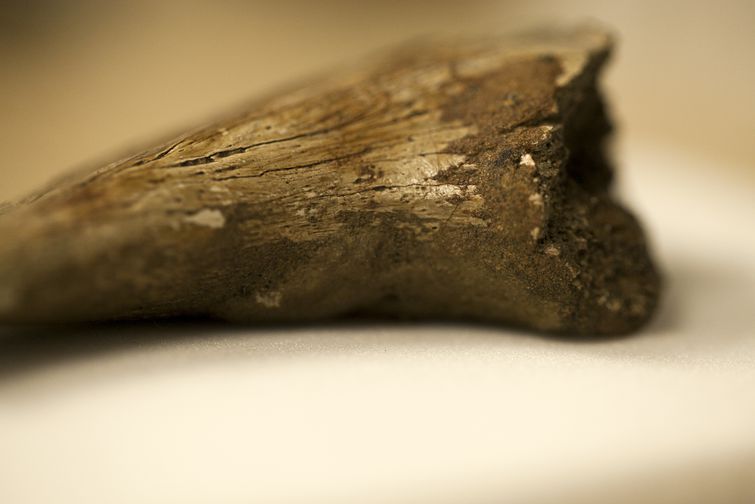
The photo above, from a new study published today in Nature Communications and led by Sergio Bertazzo of Imperial College London, shows an extremely zoomed-in view of a 75-million-year-old theropod claw, taken from the London Natural History Museum's collection. When researchers scraped tiny pieces off the fossil and looked at them under an electron microscope, they found tiny structures that look a lot like collagen fibers present in our own ligaments, tendons, and bones.
In other dinosaur fossils, the researchers found features that resemble red blood cells. Tests showed that they have a similar chemical composition to the blood of an emu (a bird thought to be a relatively close relative to dinosaurs).
  (Bertazzo et. al. 2015)
The idea that dinosaur fossils might harbor soft tissue first surfaced about a decade ago, when paleontologist Mary Schweitzer found evidence of blood cells preserved inside T. rex fossils.
But what's so exciting about this new study is that the fossils used, unlike Schweitzer's, aren't particularly well-preserved. Susannah Maidment, one of the paleontologists who worked on the paper, called them "crap" specimens. If they have preserved soft tissue inside them, it could be a sign that thousands of other fossils in museum collections do too.

How paleontologists found blood inside dinosaur fossils


For hundreds of years, most paleontologists never considered that their fossils might preserve these sorts of microscopic soft-tissue features. It was assumed that the proteins and other molecules they're made of would deteriorate in just a few million years.
What's more, looking inside them to confirm this would require that people damage the fossil, either by breaking it open or by dissolving the hard, mineralized outside, as Schweitzer did with her T. rex. "No right-thinking paleontologist would do what Mary did with her specimens," paleontologist Thomas Holtz told Smithsonian for a 2006 story on Schweitzer's discovery. "We don’t go to all this effort to dig this stuff out of the ground to then destroy it in acid."

Soft tissue extracted from a T. rex fossil by Schweitzer appeared to contain blood cells. (Schweitzer et al., 2005/Science)
Schweitzer did so after a veterinarian at a conference happened to see microscope slides of T. rex bone slices and observed that there were red blood cells inside it. But her claim remained controversial among paleontologists — even after her 2006 paper, which presented more thorough testing.
More recent chemical analysis has provided further evidence that the
T. rex bones do indeed contain blood cells, and Schweitzer has since found soft tissue preserved inside an 80-million-year-old hadrosaur. It's still unclear exactly how this soft tissue is able to survive, but some hypothesize that iron molecules might bind to proteins in the tissue, making it more stable.
This newest paper, conducted with weathered, run-of-the-mill fossils rather than pristine ones, suggests that this process might be the rule, not the exception. If so, these findings could be the first of many to come.

Dinosaur blood and proteins could tell us about their behavior and evolution


You can only learn so much about an organism from its bones. As much as we've discovered from the hundreds of thousands of dinosaur fossils excavated around the world, we're still debating whether dinosaurs were warm- or cold-blooded and how many of them had feathers.
Peering inside these dinosaurs' bones — to look at their blood cells, connective tissue, and other microscopic features — could dramatically improve our understanding of their biology as a whole. The structure of their blood cells, for instance, could hint at their behavior and physiology in ways that their bones simply can't.
The tissue might help scientists better understand evolutionary relationships between species
The new information might also help scientists better understand evolutionary relationships between species. In the study, researchers found that the proteins inside the collagen-like fibers are well-preserved, with the specific sequence of amino acids that they're built from largely intact. Amino acid sequences in proteins gradually evolve over time and vary from species to species, somewhat like DNA — so analyzing them in dinosaurs could lead to better knowledge about the evolutionary relationships between them and other species, like birds.
But there's one thing we can't do with this soft tissue: extract dinosaur DNA and make Jurassic Park a reality. Compared with collagen fibers and red blood cells, DNA is much, much smaller and more fragile.
Perhaps DNA could also be more readily preserved than thought. But scientists currently estimate that it has a half-life of just 521 years, and dinosaurs largely died off 65 million years ago.

Friday, September 12, 2014

Spinosaurus fossil: 'Giant swimming dinosaur' unearthed

http://www.bbc.co.uk/news/


Artist's impression of Spinosaurus 
 
 Spinosaurus is thought to be the largest known carnivore and would have feasted on huge fish and sharks

Related Stories

A giant fossil, unearthed in the Sahara desert, has given scientists an unprecedented look at the largest-known carnivorous dinosaur: Spinosaurus.
The 95-million-year-old remains confirm a long-held theory: that this is the first-known swimming dinosaur.
Scientists say the beast had flat, paddle-like feet and nostrils on top of its crocodilian head that would allow it to submerge with ease.
The research is published in the journal Science.
Lead author Nizar Ibrahim, a palaeontologist from the University of Chicago, said: "It is a really bizarre dinosaur - there's no real blueprint for it.
"It has a long neck, a long trunk, a long tail, a 7ft (2m) sail on its back and a snout like a crocodile.
"And when we look at the body proportions, the animal was clearly not as agile on land as other dinosaurs were, so I think it spent a substantial amount of time in the water."

While other ancient creatures, such as the plesiosaur and mosasaur, lived in the water, they are marine reptiles rather than dinosaurs, making Spinosaurus the only-known semi-aquatic dinosaur.
Spinosaurus aegyptiacus remains were first discovered about 100 years ago in Egypt, and were moved to a museum in Munich, Germany.
However, they were destroyed during World War II, when an Allied bomb hit the building.
A few drawings of the fossil survived, but since then only fragments of Spinosaurus bones have been found.
The new fossil, though, which was extracted from the Kem Kem fossil beds in eastern Morocco by a private collector, has provided scientists with a more detailed look at the dinosaur.
"For the very first time, we can piece together the information we have from the drawings of the old skeleton, the fragments of bones, and now this new fossil, and reconstruct this dinosaur," said Dr Ibrahim.

Reconstruction of Spinosaurus  
 
The dinosaur has a number of anatomical features that suggest it was semi-aquatic 
 
Life-size reconstruction of Spinosaurus 
  A life-size reconstruction of Spinosaurus is on display at the National Geographic Museum in Washington DC
 
The team says that Spinosaurus was a fearsome beast.
The researchers say that, at more than 15m (50ft) from nose to tail, it was potentially the largest of all the carnivorous dinosaurs - bigger even than the mighty Tyrannosaurus rex.
Scientists had long suspected that the giant could swim, but the new fossil offers yet more evidence for its semi-aquatic existence.
Dr Ibrahim explained: "The one thing we noticed was that the proportions were really bizarre. The hind limbs were shorter than in other predatory dinosaurs, the foot claws were quite wide and the feet almost paddle shaped.
"We thought: 'Wow - this looks looks like adaptations for a life mainly spent in water.'"
He added: "And then we noticed other things. The snout is very similar to that of fish-eating crocodiles, with interlocking cone-shaped teeth.
"And even the bones look more like those of aquatic animals than of other dinosaurs. They are very dense and that is something you see in animals like penguins or sea cows, and that is important for buoyancy in the water."
Its vast spiked dorsal sail, though, was probably more useful for attracting mates than aiding swimming.

Kem Kem fossil beds  
The fossil was unearthed from the Kem Kem fossil beds in Morocco
  
The researchers say that Spinosaurus lived in a place they describe as "the river of giants", a waterway that stretched from Morocco to Egypt.
They believe it would have feasted on giant sharks and other car-sized fish called coelacanths and lungfish, competing with enormous crocodile-like creatures for its prey.
Commenting on the research, Prof Paul Barrett, from London's Natural History Museum, said: "The idea that Spinosaurus was aquatic has been around for some time and this adds some useful new evidence to address that issue.
"But finding a more complete skeleton after the best material was destroyed in a WW2 bombing raid is significant, and this has allowed some surprising things to be found out about this animal.
"One of the things about this paper that struck me as particularly neat was the suggestion that Spinosaurus was a quadruped - all other meat-eating dinosaurs were bipeds. It would have moved in a really freaky, weird way in comparison with its relatives - whether on land or in water.
"One issue though, due to the way it was obtained - through a private collector - is that it would be good to get confirmation, such as the original excavation map, to show that all of the parts definitely came from a single skeleton."

Monday, September 1, 2014

Could Dinosaurs Have Survived?

The feathered dinosaur Microraptor pounces on a nest of primitive birds. Both species lived around 120 million years ago in what is now northern China. Credit: Brian Choo
 
The feathered dinosaur Microraptor pounces on a nest of primitive birds. Both species lived around 120 million years ago in what is now northern China. Credit: Brian Choo
Dinosaurs last lived on Earth about 65 million years ago. For many years, scientists have debated how and why dinosaurs disappeared. But improved tools and records of fossil remains have led some experts to agree about the disappearance of these ancient creatures. We get more from Jeri Watson.
University of Edinburgh researcher Steve Brusatte led the team of experts. They blamed a huge rock from space – a 10-kilometer-wide asteroid -- for the dinosaursdisappearance. Their findings appeared in the journal Biological Reviews.
“The asteroid did it.  But that asteroid probably hit at a particularly bad time.”
Steve Brusatte says the rocky object was responsible for environmental damage worldwide.  He says the asteroid caused tsunami waves, earthquakes, wildfires, acid rain and sudden temperature changes.                          
Mr. Brusatte and his team proposed that if the asteroid had struck the Earth a few million years earlier, the dinosaurs might have been better able to survive. By the time the asteroid struck, dinosaurs had already lost some of their strength
“A lot of the big plant eating dinosaurs, those horned dinosaurs like triceratops, the bottom of the food chain dinosaurs, the base of dinosaur ecosystems, those dinosaurs had declined a little bit in their diversity.”
He notes that dinosaur populations had grown and then decreased in number over 150 million years
His team’s report appears in the journal Biological Reviews.
But some plants and animals DID survive through the period of dinosaur extinction. Another study looks at one group of dinosaurs that lived through the disasters. It shows how large cold-blooded, meat–eating animals like Tyrannosaurus Rex may have developed into small, warm-blooded birds.                                              
Biologist Michael Lee works jointly with the South Australian Museum and the University of Adelaide.  He was the lead writer of the study.  He and his team centered their efforts on one group of dinosaur, meat-eating theropodsThey examined 120 species.
One group of dinosaurs was evolving, changing four times as fast as all the other dinosaurs living during that period.  And over time, the fast-evolving group became birds
The scientists studied how those changes took place over 50 million years. They say that during that time, each generation got smaller and smaller. Michael Lee says that by the time the asteroid hit, the earliest birds had been living for about 100 million years.
“The bird ancestor started exploring a new kind of lifestyle which involved smaller body size, greater agility and greater ability to regulate their body heat using things like feathers and various other things.’
Mr. Lee said smaller body size was responsible for the changes.  And that, in turn, it would have made way for changes in their body structure like the addition of wings and flight feathers.  He also noted other changes seen in modern birds, such as wish bones.
About 10,000 species of birds now live on the planet.

This story was based on a report by VOA Correspondent Rosanne Skirble and adapted for Learning English by Jeri WatsonGeorge Grow was the editor

Tuesday, July 29, 2014

Dinosaur-Killing Asteroid Struck At Just The Wrong Time, New Study Suggests


Posted: Updated:

DINOSAUR ASTEROID IMPACT

Just before a large asteroid slammed into the Earth 66 million years ago, the diversity of plant-eating dinosaur species declined slightly, a new study suggests. That minor shift may have been enough to doom all dinosaurs when the space rock hit.
The scarcity of plant-eaters would have left them more vulnerable to starvation and population collapse after the impact, with consequences that rippled all the way up the food chain.

“The asteroid hit at a particularly bad time,” says Stephen Brusatte, a palaeontologist at the University of Edinburgh, UK. “If it had hit a few million years earlier or later, dinosaurs probably would have been much better equipped to survive.”

Brusatte and his colleagues describe this nuanced view of the famous extinction in Biological Reviews.

Palaeontologists have argued for decades about whether dinosaurs were doing well when the asteroid hit, or whether they were experiencing a worldwide drop in the number of species. To explore this question, the study pulled information from a database on global dinosaur diversity, including hundreds of fossils found in the past decade.
Localized decline

The scientists used analytical methods to account for the fact that some fossil-bearing rock formations are well-studied and others are not, which could distort the apparent number and distribution of dinosaur species. They found most dinosaurs thriving right up until the impact. “If we look at the global picture, we don't see evidence for a long-term decline,” says team member Richard Butler, a palaeontologist at the University of Birmingham, UK. “In no sense were dinosaurs doomed to extinction and the asteroid just kind of finished them off.”

But in North America, in the last 8 to 10 million years before the asteroid hit, two major groups of herbivores — duck-billed dinosaurs and the group of horned dinosaurs that included Triceratops — did decline slightly. In some places multiple species shrank to just one species. That may be because cooler climates changed the types of vegetation available to eat, says Michael Benton, a palaeontologist at the University of Bristol, UK. Plenty of dinosaur groups had recovered from such small population drops before, but not this time.

A 2012 study that modelled ancient food webs may help to explain why, says Butler. Computer simulations suggested that just a small change in dinosaur diversity made ecosystems much more likely to collapse after big environmental perturbations — such as widespread climate change brought on by an asteroid impact. Plants would have withered up; plant-eating dinosaurs would have starved; and meat-eating dinosaurs would have had little to prey on.

What if?

The latest study rounds up many of the discoveries of recent years, says David Archibald, a palaeontologist at San Diego State University in California. “From my reckoning much of it is pretty much spot on,” he says. “It is almost certainly the impact that kills off the dinosaurs.” But he disagrees with some of the data. In a review in press with the Geological Society of America, Archibald compares several rock formations from near the end of the time of dinosaurs, in Canada and the United States. He finds that the two-legged, primarily meat-eating dinosaurs known as theropods were also declining.

Brusatte says that the differences boil down to how researchers account for how well-studied or well-preserved various fossil-bearing rocks are. “It’s really only now with all these new dinosaur discoveries that people are able to even think about the nuances in any kind of detail,” he says.

The extinction set the stage for the modern world, Butler notes. Although one lineage of dinosaurs survived as modern birds, mammals began their rise only after the dinosaurs were out of the picture. ”That may never have happened if dinosaurs had never gone extinct,” says Butler. ”I think it's very likely that if the asteroid hadn't hit, we would still have dinosaurs around today.”
This story originally appeared in Nature News.